Amy Coomer is an Australian author whose writing life is shaped by flexibility, persistence and a willingness to follow a story wherever it takes her.
This is part of the Interviews with Creatives series, a curated library of conversations from the Creative Momentum with Meg podcast.
For Amy, writing doesn’t happen within a perfectly structured day. She works around part-time jobs, writes late into the evening and often heads to a café to create the conditions she needs to focus. She describes herself as a night owl, someone who needs noise rather than silence, and a writer who begins without a detailed plan before eventually stepping back to consider the structure of the story.
That combination of instinct and reflection runs throughout our conversation.
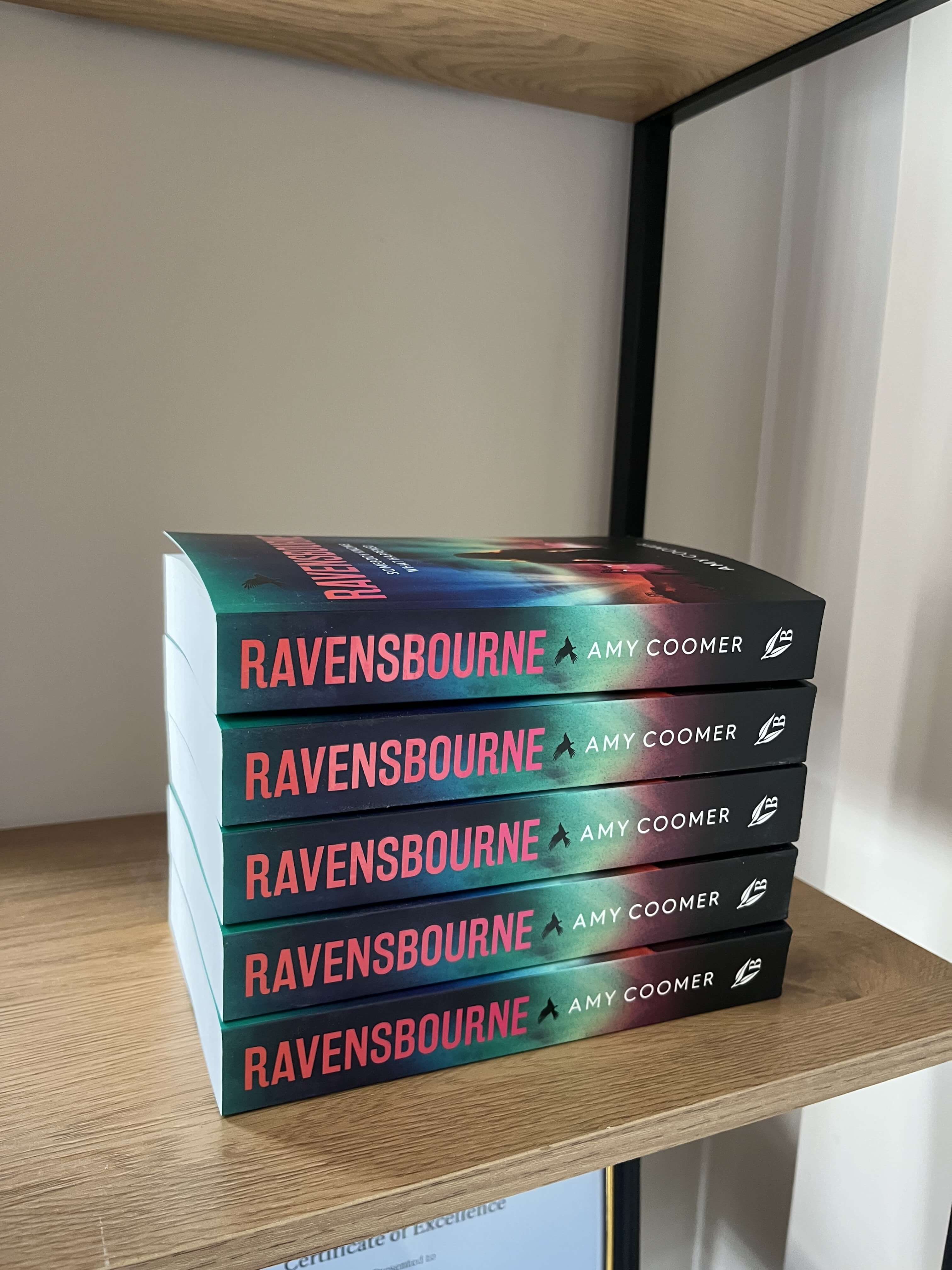
Amy has written nine manuscripts and published three novels, with her third book, Ravensbourne, due for publication in October. Her path to publication has included near misses with traditional publishing, the decision to self-publish her debut, and an unexpectedly successful book trailer that went viral on TikTok.
But the conversation isn’t simply about the mechanics of getting books into the world. Amy also speaks honestly about the pressure of social media, the comparison that can creep into a writer’s life and the temptation to measure progress against someone else’s achievements.
Her advice is direct: get off social media, protect the work and remember that the writing itself matters most.
There is also something reassuring in Amy’s description of the café as a place where she can become completely absorbed in a story. In a busy environment, surrounded by other people and everyday noise, she finds a kind of concentration that can be difficult to create at home.
Perhaps that is one of the questions running beneath this conversation: what conditions help us return to the work we love, and how do we protect those conditions from everything competing for our attention?
Listen or watch the podcast interview
Prefer to listen? This conversation first appeared on Creative Momentum with Meg. Listen below or continue reading the full transcript.

In this interview we explore
- Writing around part-time work and finding a routine that suits your natural energy.
- The relationship between being a pantser and a plotter.
- Learning to trust your creative process.
- Amy’s experience of self-publishing her debut novel.
- The role of cafés, music and other creative work in her writing life.
- Social media, comparison and protecting your attention.
- Finding a sense of flow and creative belonging
Read the full conversation below, or listen to the episode above.
Conversation with Amy Coomer
AC: My name is Amy Coomer. I am an author, and I also do a little bit of acting, but writing is definitely my biggest passion. I’ve written three novels, or I’ve published three novels. I’ve written a lot of other manuscripts, but so far I’ve just published three. My third book, Ravensbourne, is about to be published in October, in a couple of weeks, and I am very, very excited.
Creative Routine
MD: That is very exciting. Tell me, do you have a routine for your creative work, for your writing?
AC: Not really. I think I’ve just been doing it for so long now that I can sit down and do it. When I was younger, I waited for inspiration to strike, but now it’s become muscle memory. On my days off, and sometimes not on my days off, I’ll just sit down, open my MacBook and work. I would say I’m also a night owl. I’m slow to wake up in the morning, so I’ll do a bit of work during the day, and then I come alive at night again. I get a second wind, and I can never put my laptop down at night, which is very frustrating to my partner. I love to write in bed as well, so I’ll be clacking on the keyboard late at night. It’s all hours, definitely.
MD: So you’re finding time wherever you can, or making time wherever you can?
AC: Definitely. I have part-time jobs, but I’ve always tried to avoid having a full-time job. That’s not to say I don’t work full-time hours, but I’ve always tried to avoid the restraint of a nine-to-five, Monday to Friday, because I want my creative pursuits to have time during the week as well. I don’t want it to be something I’m just trying to cram into my week. I still want to prioritise it. If I have a Wednesday off, I’ll go to a café and write all day. I try to give myself that room in the week and that flexibility, so it still feels like a job. My creative work feels like a job as well.
MD: Are you writing on your working days as well?
AC: Sometimes, if I can. I used to work some slower jobs, and I would try to get some hours of writing in then. But now I work in the health industry, so it’s a little more difficult. I can’t really be distracted. I’ll come home after a shift and write as it gets dark, then have dinner and go back to writing. I’m just trying to fit it in wherever I can.
Creative Process
MD: Tell me, when you come up with an idea for a book, do you have a process to get that from idea to finished manuscript?
AC: I don’t. I know some writers are either planners or pantsers, and I am definitely a pantser. It’s been the same with all of my novels, so I don’t think it’s ever going to change. I’ll think of an idea and sit with it for a little while. I might write some notes in my Notes app. I’m a big fan of dialogue, so I’ll imagine dialogue that might be in a scene halfway through the book. I’ll start thinking of scenes and visualising the book. Then, when it’s time to write it, I’ll sit there and write as much as I can. It usually gets to about a third of the book, around 30 per cent, where I can blindly write it. Then I get to the point where I think, ‘Okay, now I need to stop and actually look at the structure and make sure I’m not going down the wrong path, and that I actually have a plot here and the beats are correct.’ From that point, I’ll outline the rest of the book. That’s generally how it’s been for all of them. I’ve written nine novels, or at least nine manuscripts, so that’s been the process for all of them.
MD: At what point did you start thinking, ‘I can trust this because it’s worked before’?
AC: Probably only when I started to publish books and share them with people. I started writing when I was very young, around 12 or 13, but I wouldn’t show anyone because I was self-conscious about it. I wasn’t sure if the books were any good because I was the only person who had read them. The first person I shared them with was actually my dad. My dad is a professional editor, so I have no idea why I kept them from him for so long. I think writing a story is such a deeply personal thing, especially when you’re young. I was embarrassed by it, and I thought that if I could get validation from agents, publishers and industry people, that would mean something. I struggled to get that validation, so eventually I thought, ‘Let’s send it to just one person. Let’s send it to my dad, who I can actually get feedback from.’ That was invaluable. I wish I’d done it much sooner because it gave me the validation that, despite the rejections I was getting from the industry, the work I was doing was good. It definitely needed an editorial eye, though. Once I teamed up with my dad to edit the manuscripts, get them up to standard and submit them, that’s when we started gaining momentum. It was the right choice to start sharing them with people.
MD: Has he stayed part of your process?
AC: He has. He’s the first one who reads my book.
MD: That is so delightful.
AC: It is really nice. That’s a huge thing we have in common: writing. He worked for a university textbook publisher for about 25 years, so he had a lot of expertise in the nonfiction world. Maybe that’s why I hesitated to send him my fiction books. I thought, ‘You don’t read fiction. You don’t know what you’re talking about.’ But he understands story really well, and we’ve made a really good team. I now show him everything. If he says it’s good, I trust him. If he says it’s not good, I argue with him, but ultimately I trust him on that as well.
MD: How far into your writing life were you when you reached out to your dad?
AC: It was right before I self-published my first book. I’d say I was probably about 23, and I ended up publishing that book when I was 24. So it was quite late in the game. I’d previously come quite close to getting a literary agent for that book and getting it published, so that was the one I was focusing on. My dad eventually said, ‘Why don’t we just self-publish it? What could go wrong?’ I’m really glad I did. I probably never would have come to that decision on my own. It was him, my sister and a few other people encouraging me to do it. The publishing landscape has changed so much. For some people, self-publishing is the only way to be seen. I have no regrets because it kick-started the rest of my publishing journey.
Self-publishing
MD: Can you tell me a little bit about the self-publishing journey? I speak with a lot of writers who are thinking about exploring that route to publication.
AC: I think there’s a bit of a stigma around it, and I shared in that stigma because of what I’d always heard: that if you self-published, it was because you’d failed and couldn’t get a traditional contract. That isn’t necessarily the case. I got very close to publishing Boys on a Train, my debut, and no one ever sees all those near misses. I self-published that book, and I ended up making a book trailer for it because I have a bit of a film background. That was another idea from my dad. He said, ‘Why don’t you utilise the skills you have and create a book trailer?’ You don’t see that very often, so I invested some money and got my friends and a small production company to create a trailer. Then I uploaded it to TikTok a couple of times. Eventually, one of the videos went viral, and that kick-started the sales for the book. It did a lot better than I ever expected, and I’m really proud of that book.
MD: Was it an e-book that you first published, or a physical book?
AC: Both. Print copies and e-books, through Amazon.
MD: I think that’s such an encouraging thing to hear because the landscape has definitely changed. I remember 15 years ago people saying, ‘You can’t self-publish’, but so many great books are self-published now.
AC: Absolutely. Some of the biggest books have been self-published. It’s incredible, so I definitely don’t think it’s something to be ashamed of. I think it’s almost a strength because you have all this control over it. It’s a great way to start, and I wouldn’t deter anyone from doing it.
Creative Inspiration
MD: Where do you get your inspiration for your writing?
AC: My internal monologue never shuts off. Whenever I’m doing some mundane task, like driving or being in the shower, my mind is always working. I’ll often start with a ‘what if?’ scenario. I think that’s common for authors. They’ll take an ordinary situation and put a spin on it. That’s how a lot of my novels have come about, especially Ravensbourne. It’s about taking an innocent experience, like a music festival, and putting a dark spin on it. Imagining the worst-case scenario, what that would look like and how it would impact all the characters.
MD: I love it. Does it start with the question of ‘What if?’ And does the story come to you through the character or through the question?
AC: I would say the question, definitely. I shape the character around that question. That isn’t to say my books aren’t character-driven because I think they are, but I like having that hook to start with and then going from there. I find that really interesting.
Filling the Creative Cup
MD: How do you refill your creativity cup?
AC: That’s a good question. It’s funny because I’ve been writing for so long now that writing is the thing that regulates me. It’s the thing that gives me energy. I love it so much, and I long to be doing it whenever I’m doing something else. It’s never really a matter of being creatively exhausted, although that does happen. I’m more exhausted by everyday life and the things outside of writing. I just want to go into my room and write, or go to a café. I can write for eight hours, leave the café and feel like I haven’t done any work. That’s the mindset I have. It’s so enjoyable to me, and it’s such a privilege to be doing this and writing these stories. Of course, I do get exhausted, and sometimes you need to come home and switch off and watch a TV show. I would say watching a film or TV show and immersing myself in someone else’s art helps me stop thinking about my own work for a while. But I love it so much.
MD: I love that because I also love watching a great series or movie.
AC: Absolutely. But then it has me thinking about my own work again. I’ll think, ‘That’s amazing. Is my work as good as that? Maybe I could do something similar.’ Or it will inspire something. It’s all connected.
MD: Once you’re doing creative work, everything feeds those questions. You start wondering how something was made or how someone achieved a particular effect. I talk with writers about reading under the hood, but I think it’s also about watching under the hood.
AC: Absolutely. It’s the same experience for me with reading books and watching films. They’re all stories, so they’re all connected. You can find inspiration from all of them, even music. I find so much inspiration from music and lyrics, and from the feelings I get when listening to certain songs. There’s inspiration everywhere.
MD: Do you listen to music when you’re writing?
AC: Always. I could never listen to silence. I listen to music, and sometimes I’ll listen to compilation videos of films. There might even be people speaking in my ear, and for some reason that gets me inspired. I need noise to relax and immerse myself in the story. That could probably drive some people mad, but I need constant noise.
MD: I think there are two camps: people who can have words coming into their ears while they’re writing, and people who need none of that.
AC: Interesting.
MD: Given that you write in cafés as well, do you write mostly in cafés?
AC: I would say so. The complex where I live is very noisy, but it’s not good noise. The noise of a café is okay for me. It’s strange what noises I can tolerate. I also like the physical act of going to a café because it feels like you’ve come there for a purpose. You’re less likely to be distracted because you’re in a café with your laptop. You can’t just go and lie in your bed or scroll on your phone. You can scroll on your phone, but you can be stricter with yourself because you’ve taken yourself to this location to write. If you’re not writing, you’re wasting your time. You think, ‘What are you doing here?’ That’s the feeling.
MD: I’m in that camp with you. I love a café because it creates a kind of discipline for me. I’m here to write.
I’ll order a coffee and maybe something to eat, but I started doing it years ago, long before COVID and before everyone was working from home.
It was this feeling that if I’d gone to the café to write, I’d look like an absolute wanker if I wasn’t actually writing.
AC: Exactly! You’re thinking, ‘People are looking at me. They know I’m not writing right now. They know I’m being lazy.’
MD: So I just need to get on with it.
AC: Do you ever write in libraries? I love a library, too.
MD: Yes. It’s the same thing. I like sitting at a big shared table, with lots of people around and that buzzing atmosphere. You can’t just sit there and browse. I mean, you could, but…
AC: There’s something about being surrounded by books, too. Being able to pick one up and read through it is amazing. There’s constant inspiration around you.
MD: I agree. Do you have favourite genres or authors?
AC: I really love Coco Miller at the moment. I’ve just read both of her books, and there’s another one coming out. I love Caroline Kepnes, I think that’s how you pronounce her last name. She writes psychological thrillers. I’m interested in a mix of psychological thrillers and literary fiction at the moment. Those are my two interests. I used to love young adult fiction, and I still do, but my taste is starting to skew a little darker as I get older. My young adult novels are quite dark as well, so I like reading in that new adult range. That’s really appealing to me right now.
Creative Wisdom
MD: If you were talking to someone who was thinking about getting into writing or another creative pursuit, or who was feeling stuck or stagnant, what wisdom would you want to share with them?
AC: I would say, get off social media. I have a few friends who are writers, and they get really bogged down. I do as well. When I first started, social media wasn’t what it is now, and that was such an advantage that I didn’t realise at the time. As great as social media is, and as much inspiration and positivity as you can find online, there’s also so much comparison. If you’re just getting into writing and you’re seeing people posting amazing deals, it can look so easy. You don’t know that they’ve also been trying for about ten years. It’s easy to get bogged down in comparison. I think you need to be strict with yourself about social media and remember that it’s a highlight reel. The work and the art are the most important things at the end of the day, so prioritise that as much as you can. Block out the noise. That’s my tip. Also, watch good films, read good books and learn from people who are better than you. Learn how they got there.
MD: I love all of that. People need to remember that social media is just the best of someone’s life, or their worst.
AC: Something I’m learning as well is that my biggest dream was always just to publish a book. Then, very quickly, the goalpost moved. Now it’s writing a bestseller, or achieving something else. It keeps growing because you’re always seeing someone who’s doing more than you or achieving bigger things. It’s terrible.
MD: It keeps nudging that definition of success.
AC: That’s the point. It always makes you feel like you’re lacking in some way, and that you need to work harder or do better. But you’re probably doing amazingly, and you just need to give yourself more credit. I definitely need to do that.
MD: Imagine being a writer in the days when there was no social media.
AC: I know. And now with AI, it’s becoming such a terrifying and unpredictable landscape. It’s probably one of the toughest times to become a writer. Everything is unrecognisable right now, but I’m hoping it will eventually settle. I hope we can get back to what we love and block out all the noise.
MD: I think people are going to crave human-made work more and more.
AC: Absolutely.
MD: The AI stuff will end up sounding all the same.
AC: I think so. I think it’s already starting to. People can detect it now. It reads as being a bit unfeeling. You can tell when something is too perfect. People are craving authenticity now, and I think that’s a great thing.
Home for Creativity
MD: What feels like home for you and your writing work?
AC: Do you mean what I feel most comfortable writing?
MD: Yes, or simply what makes you feel at home with your creative work.
AC: I would say cafés. That’s something I’ve grown to love so much. When I’m sitting in a café, deep into a story, and I’m more than halfway through and everything is clicking, that’s a feeling I’m perpetually chasing. It’s so rewarding to be in a busy café but completely focused on something. You’re in that flow state and forget where you are. It’s become this beautiful, comforting feeling that lets me know I’m on the right track with the story and in life. It’s a feeling I crave and long for.
MD: I love that. Do you have a particular café you go to, or do you share it around?
AC: I try to share it around, but I live on the Gold Coast, and there’s a café called The Oxley. It stays open until about 8 pm, which is amazing for a night owl. You can sit there and order a coffee at any time. You order through a QR code, so no one even knows how many you’ve had. You can sit there, have five coffees and stay until 8 pm. It’s a great café for a night owl because most places here close around 2 pm.
MD: I know. What is it with the 3 pm closing time?
AC: I don’t know, but I need it. One of my biggest gripes is that I want to roll out of bed at 9 am, go to a café around 10 or 11 and stay there all day. It’s just not possible with a lot of them. They kick you out at 2 pm.
MD: They come and wipe the table around you.
AC: That can make you feel as though there’s something wrong with your schedule, but you’re just a night owl. These places want to shut early, so find somewhere that stays open late and you’ll be fine.
MD: So you’re more of a night writer than a morning writer?
AC: I would say so. Because of my jobs, I have to get up quite early now. I’m starting at 7.30 in the morning, so on those days I’m not a night owl. But on the days when I know I’m not working, I’m definitely a night owl. I’ll wake up late so I can work into the night.
MD: Excellent. Thank you so much for coming along and talking about your creative work.
AC: Thank you so much, Meg. This was lovely.
Connect with Amy Coomer
Amy Coomer is a writer and actor based in Queensland, Australia. She is the author of three novels: Boys on a Train, a young adult coming-of-age novel that was selected as a finalist for the 2022 Leapfrog Press Global Fiction Prize, Rosemary Boy from Fair Play Publishing, and the forthcoming Ravensbourne from Bakers Lane Books. She is also co-creator of the dramatic TV series The Wrong One, which is currently in development with Screen Queensland.
- Instagram: amycoomer
- TikTok: amycoomerauthor
- Website: www.amycoomer.com
More interviews with creatives




Enjoyed this conversation?
If this story inspired you, encouraged your own creative practice, or gave you something to think about, I’d love you to share this interview with another writer or creative.
Creative Momentum with Meg, a podcast of conversations with creatives
This interview originally appeared on the Creative Momentum with Meg podcast, where I talk with writers and creatives about how and why they do their creative work.
Explore more conversations about creative process, inspiration, routines, challenges and the many different ways people bring their ideas to life.

S2E30: Maddy Tyers, actor, writer and producer, on collaboration and creation – Creative Momentum with Meg
Listen or watch Creative Momentum with Meg
Want to be part of the Home Season?
I’m always looking for Australian creatives of all kinds to share their stories. If you’d like to be considered for a future interview, register your interest.
Looking for support with your own creative work?
Momentum is where writers and creatives come together to build consistent creative habits, find encouragement and keep moving their projects forward.