
In this interview, I chat with Anna Woods an Auckland debut novelist on longhand by amber lamplight, Scrivener and Excel in the same process, and what Clarissa has to do with a psychological thriller set in an architecture firm.
This is part of the Interviews with Creatives series, a curated library of conversations from the Creative Momentum with Meg podcast.
Anna Woods is an Auckland-based author whose debut literary suspense novel LIT was published by Echo Publishing in June 2026. Anna has won the Sargeson Prize and been shortlisted for the Commonwealth Short Story Prize for her short fiction, completed a Master of Creative Writing, and spent years writing novels that didn’t get published before landing on the process and the story that finally did. This is a conversation about what that process looks like from the inside and why she has no intention of stopping. While Anna is not strictly Australian, she’s from New Zealand and has deep connections here.

In this conversation, we chat about:
- Anna’s distinctive drafting ritual
- Why the liminal space between waking and sleeping is where her best writing happens
- How she types up her longhand the next day as a first-pass edit
- How she builds a reverse outline in Scrivener and uses Excel
- Why she came from short fiction
- Where the idea of LIT came from
- Why reading memoir author-narrated audiobooks fills her creative cup
- Why getting out into the world is essential
Whether you are trying to find your drafting rhythm, wondering whether your process is the right one, or just needing to hear again that the writers who break through are simply the ones who did not stop, this episode will give you both the practical and the motivational. Anna is warm, precise and completely clear-eyed about what it takes to see it through.
Listen or watch the podcast interview
Prefer to listen? This conversation first appeared on Creative Momentum with Meg. Listen below or continue reading the full transcript.
Anna Woods, Author
Introduction
AW: My name’s Anna Woods, and I’m from Tāmaki Makaurau, Auckland, and I am a writer, an author, and my new novel just came out.
MD: What’s your novel’s name?
AW: My novel is called LIT, it’s out from Echo Publishing.
Creative Routine
MD: Can you tell me a little bit about whether you have a routine for your creative work?
AW: My routine’s a little bit different. My husband thinks it’s hilarious, because the way that I draft is that I have to wait until everyone’s gone to bed. I turn all the lights off in my house. I’ve got a little book lamp, a little amber reading light, so that it’s no blue light. I attach that to my notebook and I write longhand with my mechanical pencil. I find that being in that kind of liminal space between waking and sleeping, your little inner editor shuts down, and it’s just easier to write without censoring yourself. I find that the morning is good too, but just with life commitments and family, I don’t have time to do it in the morning. So the evenings are when I do that. Then in terms of the next day, when I have time in between my work and family commitments, I’ll type up what I’ve written. When I’m editing, I can do that during the day at my computer. But for writing new words, for drafting, I really have to have that little nighttime routine.
MD: And are you doing that every night, or just a couple of nights a week?
AW: It’s most nights when I’m writing a first draft. Once I’ve finished the first draft and I’m working on revision, I’ll sometimes print out and revise at night with my red pen, but yeah, it’s when I’m writing new words because I find that it’s hardest to get the words on the page. Once they’re there, I can edit them and change them, but it’s actually drawing them out and getting them outside of myself, outside of my brain, and onto the page, that’s the part I struggle with. So, that’s where I really do it every night, and then once I’m out of that phase, I can let it go a little bit.
MD: Tell me, what is your routine like once you’re out of your first draft stage?
AW: I work from home. My husband and I have a small business, so once I’m out of the first draft, I can fit it around when I need to. In the morning, I’ll get up and do the usual exercise, get the kids off to school, walk the dog, and then I’ll come home and try and do my creative work first, because once you get towards the end of the day, your emotional and creative energy is depleted. So I’ll do that work for a few hours if I have the time, have lunch, and then try and do more admin-type tasks in the afternoon. Although, quite often I’ll pick up something at about 4, 4.30, right before I have to cook dinner, which is the worst possible time, and I’ll get really deep into something. Then I have to drag myself away to cook dinner. So there’s something about that early evening, late afternoon time that I also find quite creative, but it’s just about finding those times in between all the other commitments.
Creative Process
MD: Can you talk us through a bit about what your creative process is for a story? So, first draft is handwritten, longhand. How do you go from that seed of an idea right through to that complete, finished draft you’d be happy to send somewhere?
AW: I’m a bit of a discovery writer, so I don’t have an outline. I’d love to be a plotter, because I think it’s a much more efficient way to work, but I don’t have that capability. I have to discover the story by writing it, I can’t do it in my head. What I do as I’m drafting is read back. This is where typing up the first draft really helps, because it’s kind of that first-pass editing. You’re looking at the story again and going, oh, okay, so this part might be missing. I’ll do a reverse outline as I’m drafting. Then once I have the basic structure of the story, I’ll look at it and see what’s missing. I’ll write myself little notes. I’ve got little post-it notes that I stick everywhere of scenes that I need to write because they’re missing, or I need to connect a certain scene to something that’s happening later. For instance, if I change something in the drafting, I have to go back because a new character has entered, or something like that.
MD: When you’re typing out from your notebook and discover there’s a scene missing, or you need to do more here, do you go back to the handwriting, or do you feel free enough by that stage to just type it straight in?
AW: No, I go back and handwrite it. Quite often, when I sit down in the evening, I don’t necessarily know what I’m going to write. I rarely write chronologically, so I keep a list inside my notebook of scenes I need to write or elements I want to bring into the story. When I’m not sure where to begin, that list gives me a starting point and something to work from. Then I’ll start writing that scene, and I’ll have to go back when I type it out and see whereabouts in the document it might live, whereabouts it makes most sense. I guess it grows forward, but then it’s also sort of branching out as I’m writing. Does that make sense?
MD: Absolutely. Is this the first novel you’ve written, or first manuscript?
AW: No, I’ve written a few manuscripts, as many of your listeners have. I’ve written a few manuscripts that have not been published, and I’ve changed the process over time as I’ve learned what works for me, and what works for the story. I think what happened in the past is I came from short story writing, so I was trying to write novels as though they were long short stories, which doesn’t really work. It wasn’t really until I hit on a process that worked for me that I could expand all of the subplots of a novel. What was happening is I was having this really long short story that didn’t have enough other strands to it, and so this kind of method of drafting has helped me see where the gaps are, and build out other storylines, and make it a more cohesive whole. Also I use Scrivener to draft, and I think that’s really helped my process, because I can see it all at once. I can see all the individual scenes, where they’re happening and get that overview, which makes it much easier for me to see the novel as a whole, because I can hold a whole short story in my head, 3,000 or 5,000 words. I can’t hold 85,000 words in my head. I need some sort of bird’s eye view to understand the story, and that’s when I can start building it out.
MD: Is that happening between draft two and three? If draft one is your notebook, draft two is when you type it into Scrivener, and between two and three is when you’re going, hang on, is this hanging together? What’s missing?
AW: Then I also use Excel. I know that Scrivener can do this, but I will make a little spreadsheet too, particularly for LIT, because it is a suspense novel. Certain things are revealed at certain times. So in order for the timeline to make sense, and there’s also a little element of someone being missing, so when they went missing to when something else happens, there’s a certain time period that has to elapse. To make sure that the scenes are working with the chronological timeline of the novel, it is important for me to be able to see it all in an overview at once.
MD: Yeah. I’m sure you’ve probably heard me mention how much I love a spreadsheet. Sophie and I talked at length about spreadsheets. I love that you’re using it for the timeline, and I was just talking to someone on the weekend about how great it is for doing the timelines, because you can see very clearly when and where things need to happen.
Creative Inspiration
MD: Where do you get your ideas from? We know this wasn’t the first story you’ve written, so what inspires your creative work?
AW: It very much comes from reading other books. I’ll read a book that I see something interesting in, or that I enjoy, and I think, oh, how did the author do that? Then I wonder how I could do something like that, or something different, how I could put a spin on it. Also, little ideas pop into my head. What about a story about this? Or I hear something or see something. I don’t have a really strong visual image in my head, so I’m not one of these people who has a movie playing. I hear writers talk about, oh, there’s just a movie playing in my head and I write it down. I think that’s amazing. I’d love that because you could just sit there and it’s basically being dictated to you. I’m not like that at all. It’s never images that come to me; it gives me more experiences.
For LIT, what happened was I was driving to work one day, and I spotted someone who I thought I recognised as someone who had passed away, and that’s something that’s quite common for people. When you lose someone, your brain looks for patterns and tries to recognise them. But this resemblance was so striking that I did a double take, and then another one, and I thought, oh, wouldn’t it be interesting if this person hadn’t really died, but they’d disappeared and were living some sort of secret life? I thought that’s an interesting idea for a story. So that was just sort of percolating away. At the same time, I was reading Clarissa by Samuel Richardson, which is a classic epistolary novel about gaslighting. The villain in that is a real rake, and he ruins this lady called Clarissa. Ao I was thinking, what would that be like in a contemporary setting, where she has more agency, and more control over her own life? I brought those two things together. So, it’s very much about reading and noticing things that are affecting me in my life, or that I see out and about.
MD: For the other things you’ve written, is it the same? Do you keep noticing something and think, I need to explore this?
AW: The novel I wrote for my Master of Creative Writing was an epistolary novel, inspired by letters, and then it was kind of, what if the character wasn’t writing to someone who was around? What if it was to someone who was missing? I don’t know why I have all these missing people in my novels. That one was again inspired by another novel I’d read, thinking, oh, it’s interesting to write a novel in letters, how could I work with that as a starting point for a story? Then I had very early novels in my 20s that were more of the autobiographical first novel, where you just mine your own life. But I’m quite fortunate that those didn’t get published, and I got that out of my system, and now I can work on more purely fiction. Though of course your life always comes into your stories.
Filling the Creative Cup
MD: What fills your cup creatively?
AW: Reading, definitely. I love hearing other voices and other stories. I’ve got a real thing for memoir. I love reading memoir, and I love listening to them. I don’t listen to many audiobooks, but the ones I do are memoirs narrated by the author. There’s something so compelling about hearing someone’s story told in their own words and their own voice. But then there’s also the usual things of getting out in nature, going for a walk, going to art galleries, consuming other types of art, movies, films. Just being out in the world. I think you really need to be out and experiencing life, because otherwise your view becomes quite narrow. There’s this whole thing of writers writing about writing, which is interesting to us, and I enjoy reading books about writing, but I think to speak to a broad section of people, you really need to be experiencing other aspects of life and talking about other aspects of life. So I think it’s really important to just get out there and experience things.
Creative Wisdom
MD: If you were chatting with someone who is thinking about doing some writing, or some other creative work, or is at a stagnant point or transitioning in their creative work, what wisdom would you want to share with them?
AW: I think it’s about perseverance, really, because the people that have the breakthroughs are the people that keep going. You see it time and again in all creative industries. There’s a tendency to give up at the first hurdle, and those hurdles are about learning and getting better. If my first novel had been published, it was terrible, and if I’d given up after writing that novel, I wouldn’t be here today. Not every piece of work you do is going to be something you’re really wanting to put out into the world, but that doesn’t mean you should stop working. So yeah, perseverance, keep going, and having that focus and determination to make it through.
MD: It’s classic advice, but we need to keep hearing it, don’t we? Just keep going, because it’s so easy to give up, especially when no one knows about what you’re writing.
AW: Exactly. With the Women’s Prize, which Virginia Evans recently won, Virginia said she’d written nine novels before The Correspondent was published, and now look at how massive it is. I know a lot of writers who gave up after their first book didn’t get published, and it’s understandable, because the rejection is really hard, and you do question whether what you’re doing is something that people want to read. But with every rejection you get better, and I think that holds across all art forms.
MD: I agree. With my first manuscript that got rejected by two people, I was so fragile then that I was like, oh, that’s it. That one is definitely going in the bottom drawer, and I’ve just got to try and dig deep and write something else. But while we are fragile, we do have to pick ourselves up. I’m going to pop a link to this in the show notes. Someone sent me a link to a conversation between Ann Patchett and Virginia Evans, because they wrote to each other for a long time before The Correspondent was even picked up.
AW: Wow.
MD: And Ann’s like, you know, I just kept saying to her, you go, girl! Because she didn’t know she was going to have this amazing novel. I’ve read it, I loved it. I did have to write to the publisher, because ten pages fell out as soon as I opened it, so that gave me an excuse to write a letter. Thanks, Virginia Evans!
Home for Creativity
MD: What feels like home for you and your creative work?
AW: I have a real thing about quiet. It’s not so much where I am, but the place has to be quiet. I know a lot of writers enjoy writing in coffee shops and libraries because of that white noise, but I can’t listen to music, I can’t have any distractions. I’m very easily distracted. The few times I’ve had the opportunity to go on a writer’s retreat, that’s when I’ve been the most productive. It’s not that I’m at home in my home, but I’m at home in that space of quiet where I can access the part of me that is able to come up with the stories. Yeah, I really need that quiet space to be able to do my work.
MD: I love that, because I also need quiet. I’ve been known to sit with headphones on that have got nothing playing.
AW: Yeah, I’ve heard writers talk about the playlists they write to, and I can’t comprehend the idea of having lyrics especially. I can kind of understand having music with no lyrics, but when you’re having words coming in your ear and you’re trying to write different words, my brain doesn’t work that way.
MD: Yeah, no, I’m the same. It has to be instrumental, and if I am listening to music alongside it, it has to kind of fit the theme of what I’m writing as well. Thank you for sharing your creative process. Are you writing another suspense book now?
AW: I am, yes. I’m writing another suspense novel. This one is set in the art world, so the main character is a performance artist, and that is proving to be so interesting. The research for this has been just wild, some of the stuff they do. So hopefully that one will make its way into the world soon.
MD: And for listeners who are thinking, she has a New Zealand accent, is she Australian? This is the Home season. Tell me your connection to Australia. Also, Australians consider New Zealanders like our other state anyway, over the ditch.
AW: This is true, over the ditch. My husband and my children are all Australian citizens. My husband’s Australian, he’s from Melbourne and a big Carlton supporter, so that’s not so great for us. I don’t follow the AFL, but apparently they’re not doing so well. We’re in Australia frequently visiting family, so I’ve got a great connection to Australia. We lived there for a time as well, before we were dragged over the ditch by a job.
MD: And your book was published in Australia?
AW: Yes, it’s available in all Australian bookstores, independents and the big chains as well.
MD: Thank you so much for coming along. I’ve really enjoyed hearing about your work. I’m going to say, I know quite a few writers who start with the handwriting in a notebook, and it is actually making me consider how useful that can be, because I think it’s a less critical eye we have on our writing, maybe?
AW: It’s a different voice. The words you choose are different, and I don’t know why that is, but I can tell the difference between something I’ve written by hand and something I’ve written on a screen. I prefer it, and it’s also a good way of unlocking when you’re stuck.

Connect with Anna Woods
Enjoyed this conversation?
If this story inspired you, encouraged your own creative practice, or gave you something to think about, I’d love you to share this interview with another writer or creative.
More interviews with creatives




Creative Momentum with Meg, a podcast of conversations with creatives
This interview originally appeared on the Creative Momentum with Meg podcast, where I talk with writers and creatives about how and why they do their creative work.
Explore more conversations about creative process, inspiration, routines, challenges and the many different ways people bring their ideas to life.

S2E27: Claire Zorn, author, artist and enthusiastic maker – Creative Momentum with Meg
- S2E27: Claire Zorn, author, artist and enthusiastic maker
- S2E26: Elizabeth Barnett on painting, writing and finding home in creative work
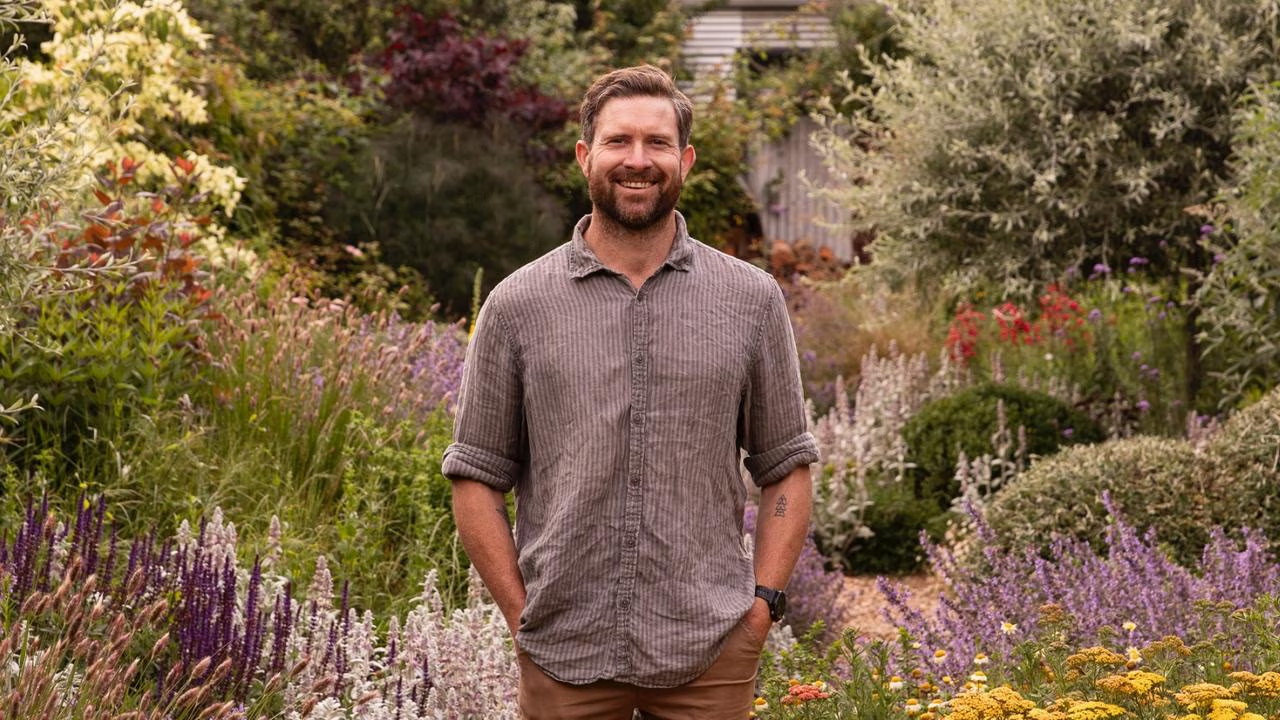
- S2E25: Tim Pilgrim on gardens, creativity and learning to work with what you can't control
- S2E24: Megan Dalla-Camina on creativity, truth and making space for what wants to come through
- S2E23: Samantha WL Lee on Building a 5am Writing Practice, Curiosity and Writing Bound
Listen or watch Creative Momentum with Meg
Want to be part of the Home Season?
I’m always looking for Australian creatives of all kinds to share their stories. If you’d like to be considered for a future interview, register your interest.
Looking for support with your own creative work?
Momentum is where writers and creatives come together to build consistent creative habits, find encouragement and keep moving their projects forward.