
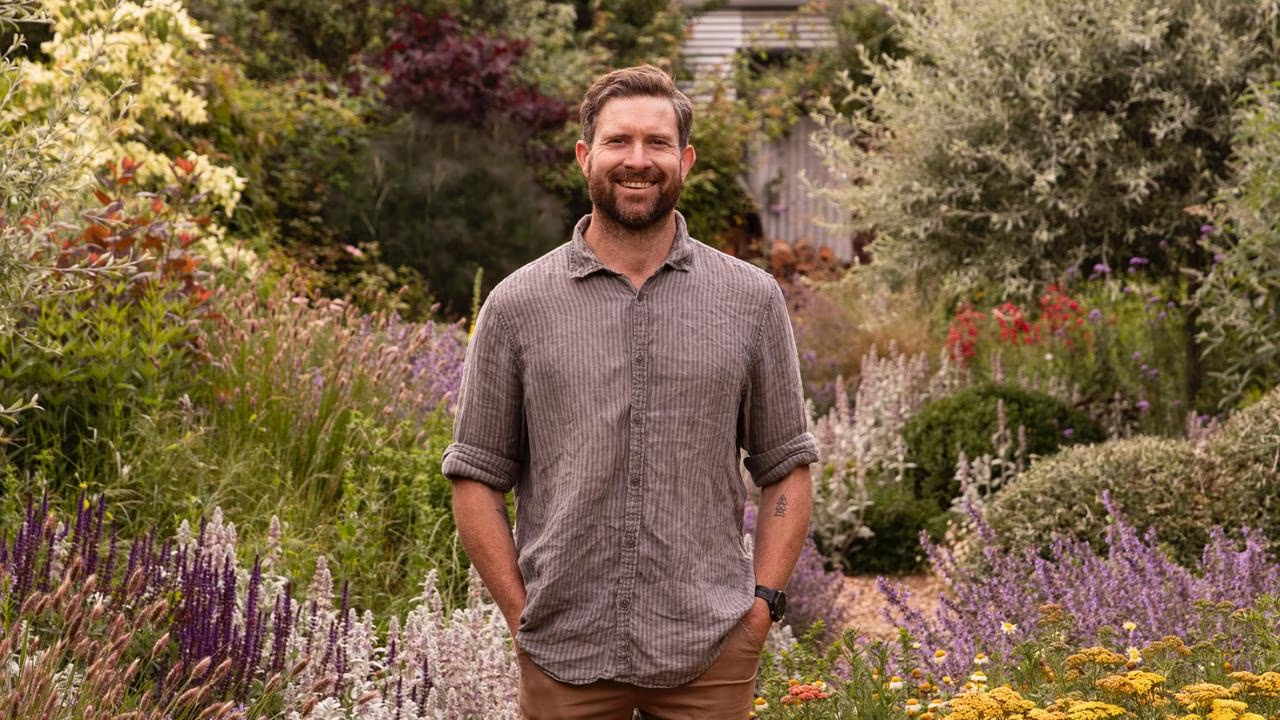
Tim Pilgrim is a gardener and garden designer based in Castlemaine, Victoria, where he creates naturalistic, plant-led gardens.
This is part of the Interviews with Creatives series, a curated library of conversations from the Creative Momentum with Meg podcast.
A garden can be designed on paper, but you don’t get to decide exactly what it will become. That might be the most interesting thing about talking to Tim Pilgrim.
As a gardener and designer, Tim works with living materials. He can make decisions about the plants, the structure, the flow and the way a garden should feel, but once those plants go into the ground, the work begins to change. Seasons arrive. Rain comes when it isn’t expected. Plants self-sow. Some thrive and take over. Others don’t survive. Birds, lizards and other creatures move in. A garden that looked one way when it was planted can look completely different ten years later.
For Tim, that’s part of what makes gardening so creative. He designs with intention, but he also has to leave room for what he can’t control.
I found that idea unexpectedly resonant beyond gardening. So much creative work begins with an idea of what we think we’re making. We have a picture in our heads, perhaps even a plan. Then the work itself starts talking back to us. Something doesn’t work. Something unexpected appears. We realise we need to remove something, change direction or allow something else to grow.
Tim describes this as the garden being “designed through time”. It’s a beautiful way of thinking about creativity.
His own career has also been shaped by this willingness to learn by doing. He began studying horticulture after leaving school, worked in plant nurseries and on sports turf, including at Wimbledon, then returned to horticulture before moving into garden design. He hasn’t followed a conventional design education, instead building his understanding through years of working with plants and gardens.
That experience has led him to a simple belief: you need to do the thing before you design it.
And perhaps that is another useful lesson for any creative practice. Before we worry too much about how something should be done, we need to immerse ourselves in the doing.
In this conversation, Tim talks about gardening as an artistic practice, the importance of observation, why he prefers big blocks of focused time, what nature has taught him about creativity, and why sometimes the best thing we can do is stop trying to control the outcome.
Listen or watch the podcast interview
Prefer to listen? This conversation first appeared on Creative Momentum with Meg. Listen below or continue reading the full transcript.
In this interview we explore
- How Tim found his way into horticulture and eventually garden design
- Why he sees gardening as a creative and artistic practice
- The value of creating blocks of focused time rather than constantly switching between tasks
- How he moves from a client’s ideas to a hand-sketched garden concept
- Why gardens are designed through time rather than finished on the day they are planted
- What observation and changing seasons have taught Tim about creativity
- Why he believes you should garden before you design gardens, and find your own voice before trying to follow someone else’s process
Read the full conversation below, or listen to the episode above.
Conversation with Tim Pilgrim, Gardener and Designer
TP: My name is Tim Pilgrim. I’m a gardener and a designer, and I’m based in Castlemaine in central Victoria. Our very small studio is one of three, and we’re essentially a plant-led design studio. We’ve had our fingers in all these different pies over the years, but we now create naturalistic-style gardens that are very plant-led. They’re site-appropriate plantings that work on low- to zero-irrigation landscapes, so it’s about putting the right plant in the right place.
There are three of us in the studio and we keep it really lean. Aside from design, we’re also kind of frustrated gardeners, so we go and look after our gardens for the first year or two after they’ve been planted, just to steer them in the right direction and make sure the management of them is going the right way. We can coach other gardeners in that way before we pass the gardens on.
We also put our hand on every plant that goes into the ground on our designs, so we get our hands dirty in that way. Aside from that, we’re shiny bums in our studio, designing gardens for private people mostly.
MD: Have you always been drawn to gardening, and what led you down that path?
TP: I can give you a little bit of my backstory if you’ve got time. I wasn’t doing really that well in Year 11. I wasn’t very engaged. I grew up in Bendigo, in Golden Square. Essentially, I wasn’t very engaged at school. Mum and Dad basically said, ‘You’ve got an ultimatum. You can stay in school, study something else or go and get a job.’
I wasn’t really too ready for the real world yet, so the first thing I thought of was studying horticulture. The local TAFE was running an intensive Certificate IV in horticulture, so I just dived straight in. I don’t know what it was. I think it might be in my blood to follow that path. I can’t remember being particularly interested in gardening before that, but I really loved it.
From there, I did that course and moved to Melbourne. I worked in retail plant nurseries for a year or so, which was a great start, but then totally flipped and went to work on sports fine-turf ovals at Scotch College in Melbourne. That took me on exchange to Wimbledon. I worked at the All England Lawn and Tennis Club for the 2008 championships.
I travelled for a few years after that, just following the wind. Then, when I returned, I met up with an old friend I grew up with in Bendigo, Julian Blackhurst, who was the head gardener at the Diggers Club. He said that if I was coming home soon, he had a job for me.
I was very lucky. I got thrown into this really immersive space that was the Diggers Club, where we learnt about planting composition, food gardening, perennial borders, dry garden plantings and bush garden plantings. We ran workshops, there was a nursery I worked in, and we grew food for the café on site.
It was a really well-rounded, deep dive back into the world of horticulture, which steered me in a heap of different paths.
After that, I went and started a maintenance business called TP Gardens, which is what it’s still called today. Alongside doing those maintenance gardens, I was a head gardener at a heap of different places, and that’s also when I started dipping my toes into design.
I haven’t studied design. I just kind of worked my way in and always felt that a good gardener should have an element of design in everything they do. Every decision made is design. Your creative decisions are being put in place, but it’s just on the fly, I suppose.
That’s essentially it, in a whirlwind. We’ve paired it all back now and firmly planted ourselves in the design world. We make gardens. That’s what we do.
MD: I love all of that. I know a lot of writers and I’ve had a lot of writers on the podcast and a lot of them talk about how important the garden is, going out there and being creative in the space. It’s like painting. You’re basically painting with plants.
TP: That’s it. I don’t think everyone comes at it from that lens, but certainly for me it was all about beauty. I wasn’t always able to articulate how I put plants together or why I put plants together, but it was always a very creative, artistic outlet, and it still is to a certain degree.
Creative Routine
MD: I was keen to interview you because I have a deep love of gardening and a deep love of Australian local plants. I got into thinking that if they came from here, then they’re more likely to survive. That was my foray into gardening.
But I’m also curious about the creative aspect of your work and your mind.
Do you have a routine for the way you go from having spoken with a client to actually designing the garden? Do you have a routine for how you go about your day?
TP: Oh, Meg, I wish there was. I feel like I’d bounce around a bit.
I think the thing I crave the most and try and work in where we can are days of focused design, focused garden care, or a day where we’re doing focused admin. But it doesn’t always work out that way.
Mondays are generally our administration day, where we’re responding to emails and working out the flow of the week and how that comes together. But really, between the book and everything that takes, I’m doing a lot more talks and speaking engagements alongside that. I’m also, when we’re winning work, meeting with clients and doing consultations. They’re often arranged three months in advance, so they’re in place before I can say, ‘I need some focus time to sink my teeth into this.’
It’s more about blocks during the day. If we can get the flow of the day started and know what we’re doing, then my colleague Josie knows what she’s up to, Emily knows what she’s up to, and I can often be on the phone talking to people. Then I leave that big wedge of the afternoon free after lunch for focused design.
What works best for me? I think traditionally my mind was sharper in the morning, but as I get older, it’s in the afternoon. That two o’clock coffee gets the juices flowing.
MD: When you were doing the book, what did that look like for you in terms of routine?
TP: Before I wrote the book, or before I signed with Murdoch, for the first time in my life I’d actually freed up a Friday. It was my day to be in my own garden. We were working together as a studio four days a week, Monday to Thursday, and I’d finally freed up that Friday. Then I was asked to write this book.
Essentially, Friday became my writing day. Rather naively at the start, I started writing for half a day on Friday. Then, in the evening, or whenever an idea grabbed me, I’d write it down. But it quickly turned out that Friday was becoming a very long day of writing as the deadlines crept in.
Closer to the final deadline, I was writing two days a week and putting away those big blocks. I’ve never done well at just stopping and starting things. It really interrupts my creative flow. I’d rather have big, quiet blocks.
The other thing that was helpful was that I went away for two separate weeks at a time to do a kind of self-enforced writing retreat. That was amazing because you can just pick up where you left off the next day. By day two or three, you’re just a writing machine, or at least you’re dumping all your thoughts and things down. That’s why it worked for me. It’s kind of a blur, to be honest. Thinking back, I’m not sure how we managed it. I’m sure it’s largely thanks to my family and my colleagues here who kept the studio fires burning.
MD: I love what you said about your own writing retreats, that by days two and three you just got into it. I know that for myself, but I also know that when people come to my retreats, I see that. Day one, they’re kind of nesting and settling in, and then they get deep into it. By the end, you don’t want to go home, but you’re also exhausted.
TP: Yeah, it’s amazing. I never thought about it. For me, it’s always been about the physical toll of gardening. I can’t control how hard I go and then I fall in a heap at the end because I’m so into it. I never realised the deep fatigue you get from concentrated writing. It’s almost like driving for a day. You’re just totally drained, mentally drained. It’s quite different from that physical fatigue. It’s a brain fatigue.
Creative Process
MD: Tell me, when you’ve just met with someone and they’ve said, ‘Here you go, I’ve got this idea for my garden’, and you come up with the design, how do you go from the idea to the end product? Do you have a process that you go through that’s kind of fine-tuned, or not?
TP: Yeah. I ask similar questions when I meet with a client. I never take notes when I’m meeting with someone. I don’t know if it’s because I’ve got a good memory and I feel that I do, but I feel that taking notes when I’m talking to someone takes away from how engaged I am or understanding them. I feel like I miss bits.
So when I meet with someone, I get them to show me around their garden. I don’t say too much. Ideas come to me at different points as we’re walking around it.
The core questions I ask are essentially about the function of a space.
How do you want this space to function?
What do you want from it?
Do you want an alfresco dining area?
Where are those special spots in the garden that you want to pause in and sit in a sunny spot in winter or a nice, shady pocket in summer?
Do you want a fire pit?
All those kinds of areas.
That’s a big part of that first picture, the flow and movement around the space. Then it’s very much about the aesthetic question: what do you like? That’s a question I ask them, but at the same time, I’m asking myself that same question. What feels right in this landscape? How do I link to it?
You don’t want to put things in, say, the bush that feel really jarring, like too many exotic plants, for example. There should be an element of connection and a sense of place.
I’m thinking about all those things. Then, obviously, it’s a budget question. How much of your money can I spend? That’s a big limitation.
The other thing that’s really key is who’s going to be looking after this space. There’s no point designing a high-maintenance garden if you’re not willing to either do it yourself or pay for a good gardener to look after it.
Essentially, I identify the zones, each kind of space and why it’s special, and how they’re linked together. We go to a lot of trouble in writing what we call a reverse brief. We show all those zones in a little sketch. We write a description about the garden as it is and everything they hope to get from it. We look at designers and gardens to reference. Basically, we paint them a whole picture about what we’re suggesting that we do.
I’m really keen on locking in those initial thoughts because I find that they’re often right, those first thoughts. Even if I drop them for a bit, I often keep coming back to those initial things that were special about a site, or the flow and movement of it. I make sure to make a record of those.
Having all that written down is really helpful once you’ve won the job and they agree to work with you. Often we park it for six months before we pick it up again, so it’s really helpful in that way.
MD: And when you start drawing, what happens then?
TP: We arrange a survey so that we have something we can put into our design software. I don’t use CAD, though, because my mind doesn’t go there with CAD. I try to stay away from design software as much as I can. I just find that my mind does not process it. I’ll learn how to do something one day, then the next day I’ll just drop it. I won’t know how to do it.
I have an iPad, so everything gets uploaded onto my program, which is Procreate. It’s essentially a programme for artists. We upload a PDF of the survey and then I scribble over that and come up with a bit of a mud map of flow and movement and tie into all those spaces. I’ll create mood boards about how every space should feel a bit different, descriptions of those spaces and how they should connect. Even before we start doing anything digitally, it’s all still very hand-sketched to start. That’s what our concept delivery is: a hand-sketched concept of the garden before we enter anything into CAD.
MD: Do you ever have to follow through on a design that you don’t really love but the client does? When they’ve pushed back and gone, ‘No, actually I want exotics in this kind of bushland area’?
TP: Yeah. It’s my job to tell them. I suppose it’s my job to do both: to listen to their brief and their wants and respond to that, but also to tell them if I don’t think something’s going to work. I’ll do as much of that as possible, but I find our process is basically two-stage. It’s the concept delivery. When we do a concept phase, it’s really a very artistic idea of how the space should work. That’s when I go back to the client and really collaborate with them and say, ‘This is what I’m thinking. This is how I see it looking. Is there anything that you’d like to tweak?’
That’s when I invite them in to be a part of their own space and tell me where I didn’t meet the brief. That’s where we try and do most of the getting-it-right stage before I go on the deep dive with material selection, plant selection and composing those spaces with the planting, which is so much of an important piece of what we do.
Creative Inspiration
MD: Tell me, where do you get your ideas from? Are there garden designers from the past or gardens in particular, or bushland? What is it that inspires the way you work?
TP: It’s definitely the landscape, the existing landscape, the wider landscape that the garden is sitting in. I think the garden should connect and echo, to a certain degree, what surrounds it. I find it too jarring otherwise. I don’t think you can have a preconceived idea about how something should look without considering the wider landscape. It’s too stop-start. It doesn’t sit well, in my mind anyway.
So definitely landscape is a big one. But I have designers that I really look up to.
We use Pinterest a lot for building our mood boards, so you get little nuggets of ideas. It’s a good way of solidifying some of the ideas you’re having if you can put a visual to it. What we do is so visual, so it’s a good way for us to go, ‘Yes, this is kind of what we’re thinking’, and then we can tweak it our own way.
You start to build your own look or feeling that you’re known for, using the same materials.
It’s also the landscape construction guys that we work with. We’re really lucky to have a trusted group of people that we work with now, and I lean on them. I make it known that I’m not the expert here. If I’m telling you something, if there’s something on the design that you don’t think is going to work in real time, or there’s a better way to do it, please let me know and we can be more dynamic.
Our design philosophy is never set in stone. It’s about adapting. If there’s a better way, working it out together and making it happen.
And you don’t get immediate results with gardening because gardens are a growing thing.
MD: Is that a source of frustration at all for you, or do you love going back to see that garden you created ten years ago because you want to see if it’s evolved into that thing you had imagined?
TP: Yeah, it is. It’s designed through time, isn’t it? It’s very different from any other creative outlet in that sense. You’re having to think months, years, even decades into the future. You have to think about this during the design process, but the truth is sometimes there are these happy accidents that happen, or you need the artist-gardener to take control.
You’ll know from gardening your own space that there’ll be a certain level of self-sowing. There’ll be a certain level which requires editing at certain times of the year, taking things out or letting things go. There’ll be a certain dominance in plants that want to take over that need to be pulled back. That’s your prerogative, your artistic eye that makes those decisions, or your experience of gardening previously and knowing what to do.
So we always design with intent around a garden in ten years. But the fact is, you can’t always control the climate. You don’t always get it right with plant selection. La Niña was a huge lesson. Some plantings we designed were around a very windy Mediterranean area, so you’re choosing things from local areas that might work really well, local native species, and other spaces like parts of Africa, the south of France, Spain and Chile that have similar climatic conditions. You could get three rogue wet years in a row and lose half of your composition to drowning, which wouldn’t have happened in other years.
All those little things happen and teach you lessons and force you to redesign or make those changes on the fly. I find it exciting waiting for a garden to mature and see what it’s going to do.
When you see a garden that I’ve done, or anyone else has done, it’s generally a photo. If it’s not in real time, then it’s just one frozen moment in time, especially in the southern states, where it’s very seasonal. I’m always excited by the next season to come.
MD: That’s one of the things I love about gardening. It’s constantly evolving and you do have to note what nature will deliver as well. One tree may grow exactly the same as another, but one’s really tall and the other is not, even though they’re six metres apart.
TP: And you might want to manipulate that too and go, ‘Well, I don’t want this tree to get any taller’, or I want to prune it in a way that totally changes the character.’ There are all those pieces of the puzzle.
MD: Which I think a lot of people are wary of with natives. I’m just going to say, if anyone’s wary, just give it a go. Get the secateurs out and have a play.
TP: The worst that happens is you get it wrong and then you get to have another crack.
What Nature Teaches Us
MD: I’m interested in what things can teach us, and there are two things I want to ask you about. One is what those years doing turf taught you for creative work in gardening, and the other is what changes to climate and nature teach you about creating gardens.
TP: I suppose what did being a groundsman working on one species, a monoculture, teach me? It taught me to be neat. Neat and tidy, and to create and maintain space, I suppose, because that’s what it is.
What I loved about it, and I’ve spoken about this before, was that some people, a lot of the people I speak to, gardeners who knew I was in that industry, thought, ‘How boring, sitting on a mower, mowing straight lines.’
But I loved it. I often likened it to monks in Zen gardens raking trees and getting it all neat because it’s kind of moving meditation in a way. You have one single focus. You can’t be anything but in that moment, which I really loved about it.
I love that about gardens as well. In fact, gardening is much better because your mind darts in all of these different directions with the creative, artistic element of it.
Making large spaces taught me to work at scale as well. I was young, in my early twenties, when I started doing that, so I was really keen to work with a team of people who were just getting after it and doing things.
I don’t know. It’s probably contributed other factors to my career that I’ve realised yet. I’m happy that I did a 180 and went from mowing grass to planting ornamental ones.
MD: And what has nature been teaching you about the creative element of what you do?
TP: I think the power of observation is huge. Naturalism, or wild gardening, is largely about observation and listening and watching and not intervening if you don’t have to.
It’s taught me to be a bit more connected. A good example is looking at a garden going into autumn, past its perceived prime of all flowering, all singing and dancing. The garden’s reached its crescendo. It’s not going to grow anymore moving into the cooler months.
But there’s so much more to see if you leave it standing. It becomes much less about flower colour and the contrast between that, and more about foliage contrast and those russet tones, movement, watching the breeze run through a garden, hearing the rattle of seed heads.
It becomes much more about those micro-interactions between everything else that uses your garden besides you. The birds coming in to take nesting material or seed, little marsupials that you spot, lizards coming in and out of walls and sunning themselves.
I think that can teach you a lot because it becomes a lot more about the ecological piece than just the beauty of it when you see something else living in your garden.
The main driver for me was always about beauty first, and it probably still is. But the second question that closely follows is: if I take this down or take this out, if I clear a site completely and then put it all back, whose home am I destroying? What biodiversity am I losing by doing that?
The climate’s, you know, the garden responds to the climate. If you’re a gardener, you’re deeply connected to what’s going on.
I think what it’s taught us in the last five years is that it doesn’t just have to put up with dry spells and 45-degree stretches of weeks on end. It has to put up with torrential downpours that might last an hour but cause huge runoff, or prolonged periods of rain that rot out your established Mediterranean-style planting.
You’ve got to be across it all.
Design Influences
MD: Are there any Australian landscape designers or landscapers who have influenced the way you see landscape?
TP: The first one that comes to mind is Sam Cox. I don’t know if you know Sam. He’s been in the industry a long time and he was the apprentice of Gordon Ford, who was the apprentice of Alice Stone, and Alice Stone and Edna Walling worked very closely together.
In a way, he’s carrying the torch of when naturalism, or that Eltham kind of bush-style garden, really began. I love what he does because it’s at one extreme end of naturalism. He’s responding directly to the landscape and vegetation around him and trying to blur the lines, almost taking the fence out of where the garden starts and where it ends.
I really like that. It’s really hard to do because it’s so subtle. If you didn’t know what you were looking at, sometimes you wouldn’t know, and I think that’s the artistry in it.
Not everyone gets it, but I love the way he comes at things and how he’s always including water for habitat. He comes from a very ecologically minded way of making space.
I also love Kathleen Murphy, who isn’t, I don’t think, practising as much anymore, but she runs an online course and is based in Gippsland now. She was in the Macedon Ranges somewhere.
It’s not 100 per cent native, but she uses a lot of natives. She responds really well to landscape and she connects seamlessly. I just love what she does.
There are plenty of others too. I’m sure I’m going to leave some people out.
MD: I was actually wondering if there was an Edna Walling influence, and I love that there’s almost like this family tree from Edna down.
TP: That was a really fascinating part of my book because I wanted to paint the picture from an Australian context about how there’s a new wave, a new perennial movement that happened in the Netherlands and Germany around the ’70s. Even further back there was William Robinson from Gravetye Manor, who wrote The Wild Garden in the 1870s or something.
There are all these different links that come in from Europe and the UK. I chased it back in the Americas as well, but I was really keen to see how all of that related to the Australian way. I honestly think that they paved the way in Australia for sure. There weren’t too many people using the native flora, the local native flora, in a garden setting before that, and Edna and Alice were pivotal in that movement.
I think we’ve still got a long way to go, which is really exciting. We’ve got this amazing range of native flora that we haven’t yet really experimented with enough and put on the garden stage, if you like.
MD: Yeah, I agree. It’s exciting to see what’s going to happen.
Filling the Creative Cup
MD: Tell me, what fills your cup creatively? For instance, I love to sit and have a read or go and look at some art or sit in the garden as a way to restore myself.
TP: I love to go out and talk to people, look at gardens and communicate with other gardeners through talking about them. People who are doing it every day in their own way can teach you a lot. You can’t really beat seeing another garden in person. That’s pretty inspiring, and I’d like to do more of it. I’m sure all designers and gardeners would like to do more of it because there’s so much to learn. It’s very easy to get stuck in your own little garden worlds. You put yourself up in your studio or your garden, and it’s always great when you can go out and see what other people are doing.
Apart from that, I’m a runner, so I like to go and run in the bush. I also like to surf. My boys and I like to go surfing. We’ve got a couple of mates who are frustrated surfers living in central Victoria, so we try and get out and do a bit. It’s a really good way to connect with something greater than you. I think it’s always about that experience.
When I need to be refreshed, it’s always going back to that single focus. When you’re in the surf on your surfboard, you can’t really be thinking about anything else but what you’re doing. Listening to the rhythms of the ocean and waiting for a wave, it’s pretty good to go and reconnect and refresh yourself.
And then camping, sitting around a fire and staring at a fire. We do a lot of that. In fact, our garden at home, every weekend we cook on the fire if we can, whether inside or out. Our garden is based around a fire pit because that’s where all the family gathers at the end of the day and periodically through the day.
Creative Wisdom
MD: Can you tell me, if you were talking to someone who’s thinking about getting into designing gardens or writing a book about what they do, what wisdom would you want to share with them?
TP: Well, getting into design, I’m not sure I did it the right way, so I probably wouldn’t recommend that. I always find the hard way to do things.
But in my wisdom, and having learnt from my own failures, I’d say that the thing I did right was to get a good understanding of horticulture and plants before I went into it, because I think that’s really paved the way for what I do.
I’m not sure that’s the same for everyone getting into landscape architecture or garden design, but if they’re just coming out of school freshly into it and they haven’t spent too much time with their hands in the earth, I think it’d be really hard. I always find that plants are the flesh on the bones of the hardscape or the design. Without a good understanding of the flesh, it looks a bit unfinished. I’d always recommend going and gardening first before design.
As far as writing and doing something creative like that, I think the thing I did rather naively, but that worked, was just not overthinking it. Come up with a clear process of what you want to write about and just find your own voice. Do it your own way.
I could have got myself in trouble if I’d gone, How do I write a book? How does everyone else write a book? I didn’t want to write anything that wasn’t from my own first-hand experience, and because of that, I could use my own voice.
I respect that when I read other people who you can tell have really been in it and really immersed themselves. I’d say find your own voice.
MD: I love that. And also that piece of wisdom about garden before you design. I think that can actually go right across any creative thing that anyone is doing.
Immerse yourself in it.
You want to be a writer? Read.
You want to be a gardener? You want to design gardens? Garden.
Do the thing so you understand it, from the making of it as well as absorbing it.
Home for Creativity
MD: What feels like home for you and your creative work?
TP: My own garden’s pretty great. I mean, it’s not great. It’s awful. I would never really want to show anyone my own garden, but it’s a collection of all of my own little experiments going on, my own little laboratory where I can play with composition and different styles and different soil profiles and mulches and all of those things.
But, yeah, home for me is a box-ironbark forest in central Victoria.
I grew up running around in the bush in Lockwood in South Bendigo, at my grandparents’ bush property. I feel like I’m drawn to other places with similar landscapes. I wrote in Wild by Design that I’m drawn to these places, and through the research of the book I was trying to talk about that sense of place and what that really meant.
There are two other places we go to without fail besides where we live every year. One is Whitfield in the King Valley in the northeast of Victoria, where my wife was born. The other is Aireys Inlet around Anglesea. They’re two of the only other box-ironbark forests, and that’s not by choice. I didn’t go there for that. But there must be something about that forest that keeps calling me back. It’s not that pretty at certain times of the year. It’s very dry and harsh, but for some reason it grounds me. There’s something beautiful about those dark trunks.truth for what I feel wants to come through me, versus through any of the other billions of people on the planet, that feels like I’m home.
Connect with Tim Pilgrim
More interviews with creatives


Enjoyed this conversation?
If this story inspired you, encouraged your own creative practice, or gave you something to think about, I’d love you to share this interview with another writer or creative.
Creative Momentum with Meg, a podcast of conversations with creatives
This interview originally appeared on the Creative Momentum with Meg podcast, where I talk with writers and creatives about how and why they do their creative work.
Explore more conversations about creative process, inspiration, routines, challenges and the many different ways people bring their ideas to life.

S2E30: Maddy Tyers, actor, writer and producer, on collaboration and creation – Creative Momentum with Meg
Listen or watch Creative Momentum with Meg
Want to be part of the Home Season?
I’m always looking for Australian creatives of all kinds to share their stories. If you’d like to be considered for a future interview, register your interest.
Looking for support with your own creative work?
Momentum is where writers and creatives come together to build consistent creative habits, find encouragement and keep moving their projects forward.